
In a world where competition intensifies every day, a true automaker is one that can rapidly turn ideas into vehicles on the road. Today, superiority in the automotive industry is no longer limited to quality and price alone; time has become the decisive factor. Speed in design, development, and bringing products to market is the key to success.
Over recent decades, the global automotive industry has experienced a major leap in design and production processes based on shared platforms. By shortening the gap between concept design and mass production, companies have managed to stay at the forefront of competition. This success is the result of precise resource management, smart planning, and the use of advanced technologies.
In this report, through an analytical review of the product development path in the country’s automotive industry over the past decade, we assess the performance of domestic players against global standards. The aim is to clarify challenges and identify capacities that can serve as the engine of future progress.

1. Global Approaches to Platform and Product Development: A Benchmark for Competitiveness
Globally, automakers striving to survive and grow in a competitive market continuously seek to minimize product development timelines. This process—from initial design to mass production and market launch—includes complex engineering stages, safety and performance testing, and continuous optimization. According to available data, this timeline varies significantly across different regions of the world, reflecting different levels of technological advancement and managerial efficiency.
In Europe, the design and development of a complete platform-based product takes, on average, between 48 and 60 months (4 to 5 years). This timeline reflects high precision, strict adherence to standards, and comprehensive testing during development. For example, in Germany, the platform design and development timeframe typically ranges from 36 to 48 months.
In the United States, the figures are not significantly different. For instance, Ford has reported that the full design and development of a platform at the company takes a maximum of 52 months. Additionally, implementing a facelift on an existing product requires approximately 21 months.
In contrast, China has made remarkable progress in recent years and has significantly reduced the time required for platform and product design and development. In China, this process typically takes between 24 and 40 months (2 to 3.5 years). This figure reflects agility, rapid decision-making, and extensive use of technology in this Asian country.
These statistics serve as an important benchmark for evaluating automaker performance at the international level and demonstrate how process optimization can lead to significant speed in introducing new products.
2. Performance of Domestic Automakers: Platform and Product Development Trends in Iran
Over the past decade, efforts to develop new products based on indigenous or localized platforms have been initiated by the country’s two major automakers. Projects such as Tara, Reera, and Shahin reached the product stage after 36, 57, and 72 months respectively. Meanwhile, despite the implementation of the joint Shahin–Aria project, a final product has yet to be realized even after five years.
This prolonged timeline may indicate poor resource management and a lack of precise planning within these companies. Frequent management changes at major domestic automakers—leading to shifts in managerial structures and corporate policies—can be considered one of the main causes of these delays and challenges in the design and development of new products.
3. An Agile Approach to Product Development: Kerman Motor Company
Beyond the two major state-owned automakers, Kerman Motor is the only private automaker that has undertaken platform development to date. Having begun its activities with vehicle assembly, the company has in recent years moved toward designing and developing proprietary platforms, taking steps toward becoming a full-fledged automaker. Based on available information, Kerman Motor has pursued platform-based product design and development at various stages and has implemented several projects in this area.
The “Eagle” Vehicle Based on the PS1 Platform
Kerman Motor began the facelift project of the JAC J4 based on the PS1 platform in January 2022. The prototype of the “KMC Eagle” was completed in spring 2024, and delivery of the first batch was scheduled and executed for spring 2025. This timeline shows that Kerman Motor managed to complete the facelift and product readiness process in approximately 2.5 years (30 months), which is considered competitive and acceptable compared to global standards (21 months for a facelift at Ford).
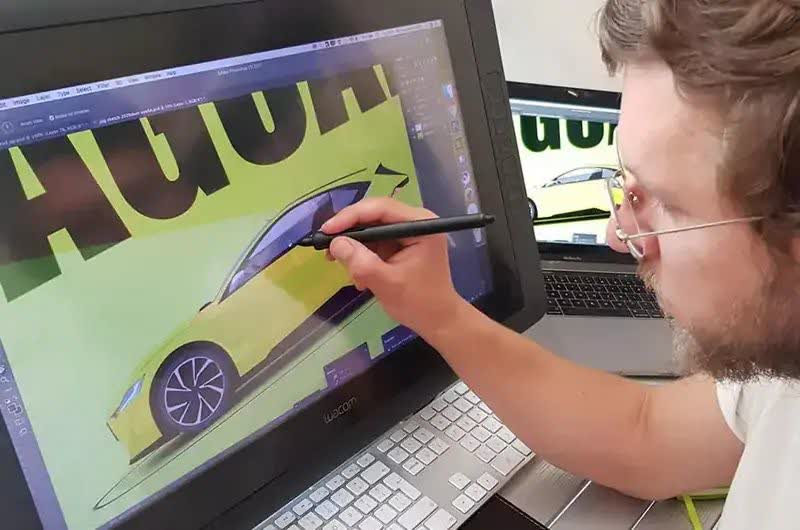
Design and Development of the “KMC Shadow” Based on the PS1 Platform
An examination of the development process of the new “KMC Shadow” vehicle (PS12 project) indicates that Kerman Motor successfully brought this product—based on the domestic PS1 platform—to the prototype stage in a relatively short time. This project, which began in July 2023, concluded with the production of the first prototype in June 2025, taking only 23 months.
Compared with typical automotive industry timelines—for example, the 24 to 40 months required in China for platform and product development—the process for “Shadow” can be considered relatively compressed. It is also faster than comparable domestic projects such as Tara (approximately 36 months to mass production) or Shahin (more than six years). However, it should be noted that direct comparisons between projects have limitations if factors such as depth of design, level of localization, and dependency on foreign components are not taken into account.
Kerman Motor’s shift from pure assembly to independent product development cannot be viewed merely as a technical transformation; it is also a sign of an effort to compete with the main players in the domestic automotive industry. At a time when many companies face various technical and operational challenges, Kerman Motor’s ability to advance localization projects raises the question of whether this path can serve as a model for other domestic automakers.
KP21 Project: Development of Kerman Motor’s Indigenous SUV
The KP21 project is, in fact, the development of a full-size SUV on Kerman Motor’s proprietary KP2 platform. Planning for this project was carried out in 2024, and execution began in 2025. As the first product on the KP2 platform, this vehicle features a gasoline powertrain and will be offered with relatively comprehensive options. The project includes industrial design, one-to-one modeling of interior and exterior surfaces, engineering design, simulation, tooling of metal and polymer parts, prototype vehicle construction, and in-house calibration. Mass production is scheduled for the first half of 2027.
Prior to initiating the KP21 project, the platforms that a global automaker must possess to develop products were reviewed. As a result, a platform for full-size vehicles—named KP2 at Kerman Motor—was selected. On this platform, three vehicle types (SUV, sedan, and van) with gasoline, hybrid, and REEV powertrains have been defined. The first product is a gasoline-powered SUV, the development of which began in early 2025.
This vehicle is designed at a near full-option level and will be equipped with Level 2 ADAS driver assistance systems. The selection of the KP2 platform in 2024 followed an analysis of comparable platforms such as KMC SR6 (MIS platform), A5 (G01 platform), and Volkswagen Tiguan (MQB platform). One of the key criteria was adaptability to different powertrains (gasoline and hybrid), which ultimately led to the design and development of Kerman Motor’s proprietary platform.
The KP2 platform has been fully and exclusively developed by Kerman Motor. After defining the required specifications, the platform was selected and designed, and the KP21 project commenced with its development. Various strategies were examined for developing the first product on this platform, ultimately resulting in the planning of a coupe-style SUV with dimensions similar to the KMC K7 and a design inspired by the Dignity, Mercedes GLS, and BMW X4.
With the discontinuation of the KMC K7, the KP21 vehicle is intended to replace it, featuring similar dimensions and an updated design on the KP2 platform. For the first product, a gasoline powertrain has been selected, while hybrid powertrains are being developed simultaneously. A Level 2 driver assistance system with upgrade capability to Level 4, along with a 1.5-liter TGDI engine and a 7-speed transmission, has been considered.
According to the project timeline, the first prototype will be produced in autumn 2026, VP samples in March 2027, and final production will begin in the first half of 2027. Interior and exterior styling have been defined, and negotiations have been conducted with several Chinese companies to build one-to-one models for physical review and potential refinement. The model is currently ready and under review by the Styling Design Management and the Product Development Department.
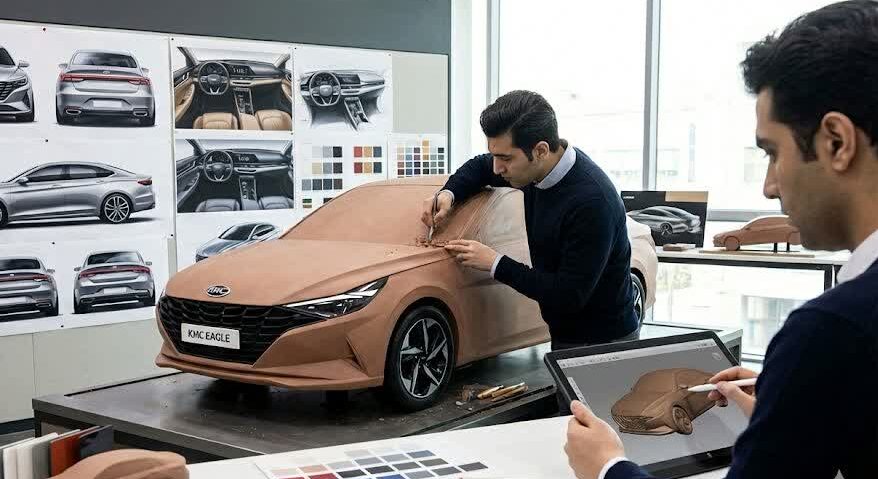
Thanks to teamwork within the Product Development Department and experience gained from previous projects, most of the detailed design stages are being carried out by Kerman Motor’s engineering design team. Negotiations with system suppliers and toolmakers for subsequent phases have begun to ensure adherence to the project schedule, and product and vehicle engineering activities are also being conducted in-house.
Alongside the start of the KP21 project, the production of the first prototype of the Shadow project has also been managed as a key challenge. Currently, dynamic testing and tooling acceptance for Shadow have been completed, and all metal and polymer part molds have been packed and prepared for shipment to Iran. After transfer, HLT processes will be carried out at suppliers’ sites to begin part production for the SOP phase.
Initial Shadow prototypes have been built, and calibration and type approval processes are underway. According to the plan, after mold transfer to Iran, the pre-production phase will begin in December 2025, and mass production of the Shadow hatchback will commence in winter 2025.
The pre-production process for KMC Shadow includes three phases for producing 20, 30, and 50 units to evaluate all vehicle and production line aspects, after which final production will begin.
The Importance of Speed and Capability in the Future Automotive Industry
A comparison of platform-based product development trends in global and domestic automotive industries over the past decade reveals several key insights. While leading global automakers—especially in China—have significantly reduced development timelines and reached highly competitive levels, major disparities remain domestically. Large projects such as Tara and Shahin, despite substantial investments, highlight challenges and delays rooted in managerial and structural issues, as well as the absence of a stable and comprehensive roadmap.
In this context, the development of projects such as “KMC Shadow” at Kerman Motor presents a different picture from what has been seen in similar projects. By relying on the PS1 platform, this automaker has advanced a new hatchback to the prototype stage in less than two years—a timeline that is unprecedented by domestic standards. Although it is still too early to make definitive judgments about final quality or market success, the speed of progress indicates relative agility in decision-making and execution.

At a time when many automotive projects in the country fall victim to bureaucracy, decision-making instability, or managerial misalignment, Kerman Motor’s experience suggests that product development within a reasonable timeframe is achievable—provided there is process cohesion and a clear industrial vision.
This comparison demonstrates that in today’s competitive environment, speed of product development and reduced time-to-market are no longer advantages, but necessities. Experiences such as Kerman Motor’s projects show that with efficient managerial and technical approaches, overcoming the common challenges of the automotive industry is possible.
Achieving this requires serious attention to competence, managerial stability, and support for agile, results-oriented approaches at all decision-making levels, so that Iran’s automotive industry can also have a meaningful presence on the global stage.